

The demand for a “Sikh province” in Punjab is one of the most significant political and historical issues in post-independence India. It is closely linked with Sikh identity, linguistic reorganization, federal rights, and the evolution of regional politics. To understand this demand properly, it is important to look at its historical background, political movements, and how it shaped modern Punjab.
Historical Background: Partition and Sikh Political Identity
The 1947 partition of British India into the present-day states of India and Pakistan triggered a demand for separate statehood for Sikhs. Sikhs suffered the loss of land and property, as well as the forcible relocation of their community, as the Province of the Punjab was partitioned between the two states. The Sikh community was further traumatized by the forcible relocation from Pakistan, as a number of Sikh religious and historical sites also ended up in Pakistan. These traumatic experiences of mass relocation, the loss of land and properties, and the loss of sacred lands and sites fueled the desire for self-determination among the Sikh community in India. In the years following India’s independence in 1947, Sikhs began to articulate their demand for self-determination in the form of greater political representation and the establishment of institutions to protect their identity and their religious and cultural rights.
This time also saw widespread acceptance for the idea of reorganization of the states of India based on the languages spoken in the states. Punjab in North India has a majority of the Punjabi-speaking community and this demand was not for separation from India, but for the establishment of a state where the Sikh community would have a socio-political space to ensure the protection of the Punjabi language and Sikh cultural identity.
The Role of Shiromani Akali Dal and the Demand for Punjabi Suba
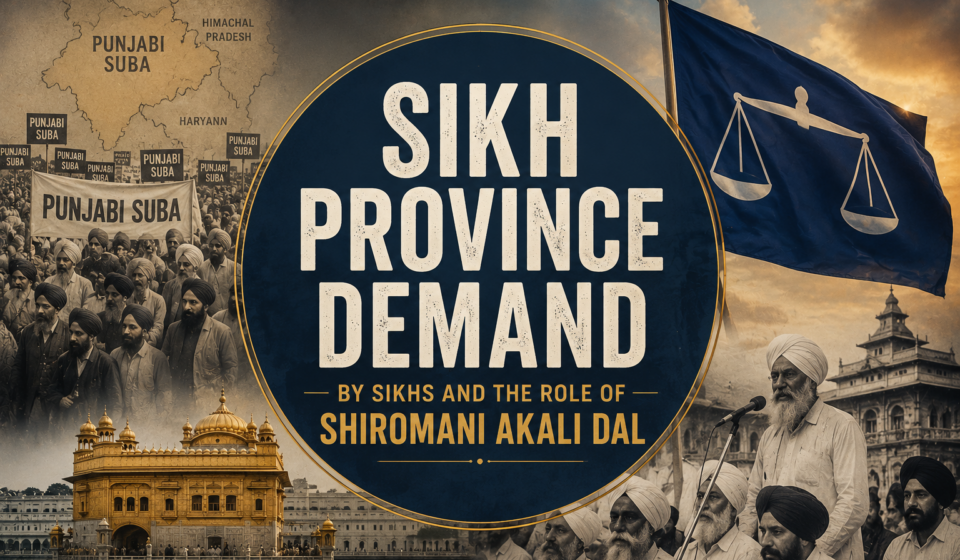
A political party that played a major role in the articulation and representation of Sikh political demands was the Shiromani Akali Dal. The Akali Dal was primarily concerned with the establishment of a Punjabi-speaking state and the articulation of the demand was referred to as the “Punjabi Suba” movement.
Demand for Punjabi Suba was linguistic, cultural, and political. The Sikhs, who dominated Punjabi regions, lent a strong Sikh identity to the demand. Protests and political negotiations were coupled with sustained friction with the central government.
In 1966, the Punjab reorganization by the Indian Government was the result of sustained efforts by the Akali Dal. It led to the formation of a smaller Punjab, with Haryana carved out for the Hindi speakers and parts of Punjab merged with Himachal Pradesh. The Akali Dal was pleased by the outcome.
Dissatisfaction was not over. The Sikh leaders felt that the reorganization failed to give control over the river waters, finances and Punjab’s administration. These issues continued to bring friction and dissatisfaction to the relationship.
From Autonomy to Conflict: The Punjab Crisis
In the case of the Punjab crisis, the dissatisfaction in the 1970s and 1980s was not just for Sikh political rights. Increased dissatisfaction stemmed from the sharing of river waters, the status of the Chandigarh (the capital of the two Punjab’s) and the economy.
These radical demands for a separate Sikh state of Khalistan were not supported by all. The Shiromani Akali Dal was committed to the federal structure of Indian politics, although there were internal factional differences.
The early 1980s saw increased militancy in regions of Punjab. The Indian government instigated Operation Blue Star in 1984 as an attempt to remove armed militants in the Golden Temple. This operation had serious emotional and political implications for the global Sikh community.
The remaining years of the 1980s and early years of the 1990s saw the prolonged insurgency and serious counter-insurgency in Punjab. Political stability was almost nonexistent in the region and thousands lost their lives. Eventually, the insurgency subsided and the region once again started operating in the framework of democracy.
Modern View: Decline of Separatism and Unresolved Federal Concerns
Post 1990, there was a significant reduction of demand for a separate Sikh state in the mainstream politics of India. The primary focus of Sikh politics shifted to agricultural issues, employment, state water issues, and autonomy of the state in the Indian Constitution.
Demands for a separate Sikh province are no longer a priority in politics in Punjab. Regional political parties like the Shiromani Akali Dal focus on providing Sikh identity within the framework of the Indian Constitution and strengthening federalism.
Political negotiations are still significantly affected by some historical issues. Disputes between the central government and Punjab continue to be about the allocation of resources and river water. Due to its agriculture and Sikh majority population, Punjab is the focal point of these negotiations.
Sikh diaspora communities in Canada, the UK, and the US tend to be more vocal regarding separatist sentiments than many political groups in India. Because of this, separatist Sikhs in India are not the only players in this situation.
The struggle for Sikhs in India to have their own state has moved through several phases. It began as a movement to have a Linguistic reorganization of the state to now having self- autonomy and the right to self- govern their own affairs. At times, demands have been of complete separation from the Indian Union.
Currently, the majority of Sikh political activity in India occurs through the present national and state political institutions. However, the earlier movements for self-determination have created a legacy which continues to influence the political scene in the Punjab in India.