
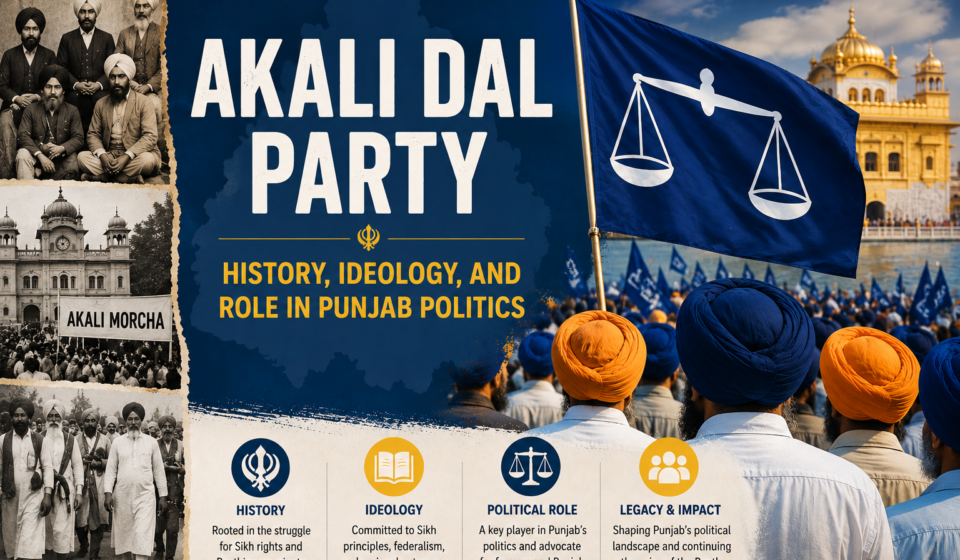

The Akali Dal Party, officially known as the Shiromani Akali Dal (SAD), is one of India’s oldest and most influential regional political parties. It has played a defining role in Punjab’s political landscape for decades, especially in representing Sikh interests and shaping regional governance. To understand its importance, it is necessary to look at its origin, ideology, leadership, and present-day challenges.
Akali Dal was formally established in 1920, around the time of the Sikh Gurdwara Reform Movement that began in the 1920s. The British supported corrupt mahants who managed gurdwaras (Sikh temples) in the colonies, and Sikhs wanted a way to gain control over their own gurdwara’s a movement that included peaceful marches to reclaim gurdwaras, Sikhs organized themselves into “Jatha’s” (volunteer groups). Akali Dal’s advocacy resulted in the passage of the Sikh Gurdwaras Act in 1925, which established the Shiromani Gurdwara Parbandhak Committee (SGPC) and gave Sikhs control over their own gurdwaras. This act solidified Akali Dal’s prominence and strength as the principal Sikh representative.
Must Read: Akali Movement (1910s): A Major Reform Chapter in Punjab’s History
Partition and subsequent changes in Punjab, as well as the rapidly altering Sikh demographic, transformed Akali Dal from a Sikh religious reform forum to a political forum dealing with the issues faced by the people of Punjab and the Sikhs. This party-based political activity of Akali Dal started after 1947 when India gained independence.
Ideology of Akal Dal Party
The ideology of Akali Dal is primarily based on Sikh identity, regional autonomy, and federalism. The party has historically supported greater rights for states within India, arguing that Punjab should have more control over its own resources, culture, and administration.
A key ideological demand of the party in the 20th century was the creation of a Punjabi-speaking state, which was achieved in 1966 when Punjab was reorganized on linguistic lines. However, tensions continued over issues such as river water sharing, agricultural policies, and federal powers.
The party also promotes Sikh religious values and maintains a close relationship with Sikh religious institutions, especially the SGPC. This religious-political link has often shaped its policies and voter base.
The Akali Dal and the Indian National Congress are the dominant political parties in Punjab. Akali Dal has formed many state governments from the 1990s, independently and in coalition with the Bharatiya Janata Party (BJP).
The Akali Dal representing moderate Sikhs wanting autonomy in India with no separation was significant during the 1980’s Punjab insurgency period of India when military operations and violent separatist movements were underway.
Role of Akali Dal Party
After insurgency, the focus of Akali Dal was interrupted by agriculture and rural governance. Because of Akali Dal concern for the rural people, the party’s government emphasized rural infrastructure and welfare and irrigation for farmers because the agriculture economy of Punjab is heavily vested.
This paper maps the political trajectory of the Akali Party in India’s Punjab state: as the long-dominant political force in the state, its core rival is the Indian National Congress. It has formed state-level governments multiple times since the 1990s, holding power either independently or in coalition with the Bharatiya Janata Party. During the 1980s insurgency, the state was mired in unrest; the party positioned itself as a representative voice for moderate Sikhs, pursuing autonomy within the framework of the Indian Union. In the post-insurgency period, it aligned itself with the state’s local agriculture-dominated economic identity, shifted to development-focused politics, and advanced three core sets of governance priorities.
Challenges and Criticisms
Akali Dal has a long history, and its opponents construct their criticisms from that. For example, some critics say the party mixes religion into the politics (which some say only increases tensions along identity lines) and say it has a dynastic style of politics. Those who say it has a dynastic style of politics would say that leadership has been concentrated in a few families.
More recently, the party has lost ground electorally after it broke its alliance with the BJP (after the reforms of the party that suggested the end of the MSP) because it has lost its core support in the rural Sikh community.
Contemporary Position
Currently, there are many political parties in the region that are competing with the Akali Dal. Despite this, it continues to have regional importance. Part of these politics includes their advocacy for the rights along the lines of the Federal system and welfare of the farmers of Punjab and advocacy for the Sikhs in politics. Along with them, the Aam Aadmi Party has become competitive in Punjab, as well.
The Shiromani Akali Dal is one of the most historically important political parties in Punjab, because of its integral role in Sikh politics. Its history is tied to big changes in Punjab, especially in the 20th century. It has participated in politics from the religious revival movements to offering governance. Although its influence has waned, it has not become entirely inconsequential with the emergence of other political parties. Its role in the politics of cultural identity remains important, alongside its stake in the debates concerning the federalism and agriculture in the state.