

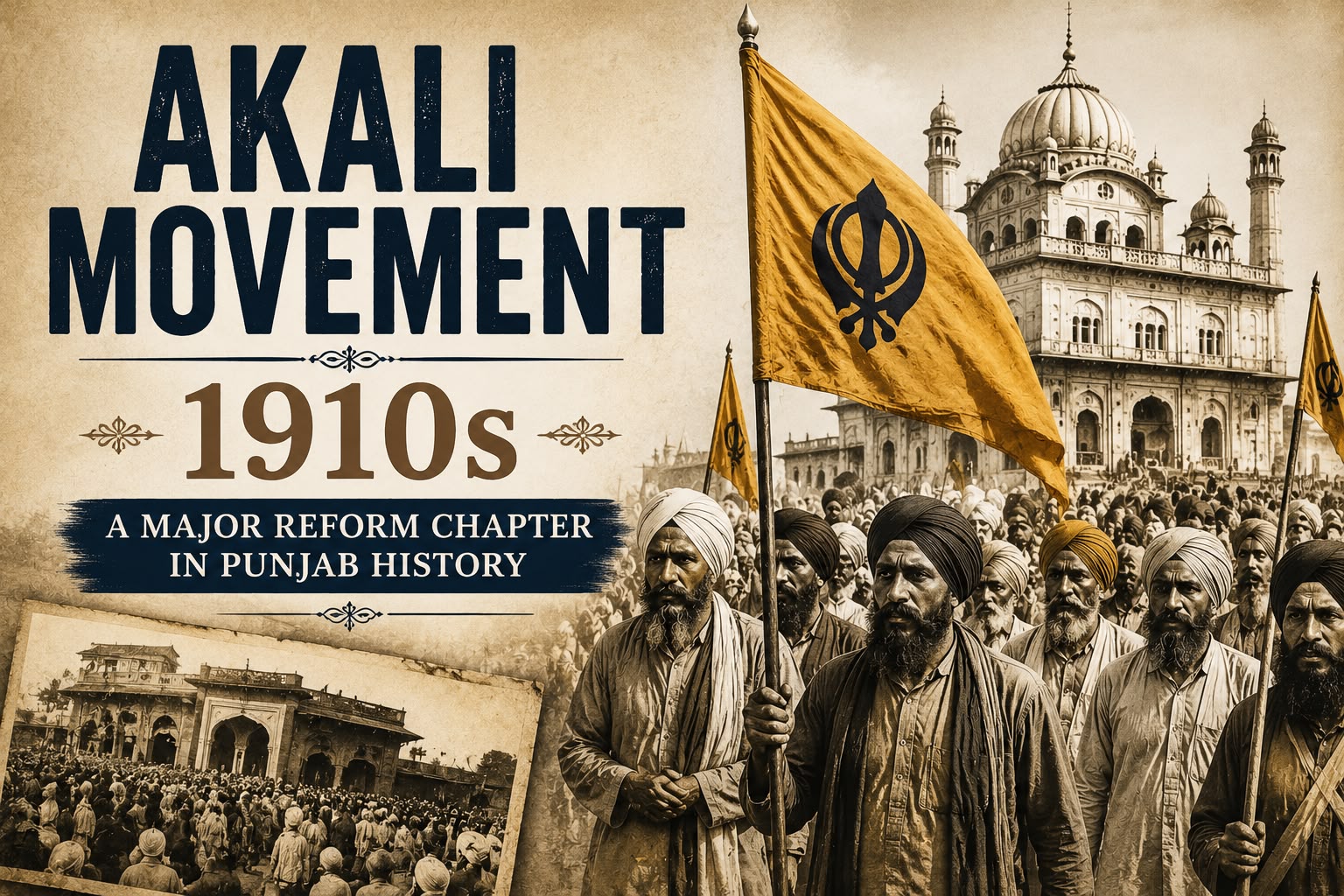

The Akali Movement, which gained momentum in the early 1910s, was one of the most important socio-religious and political reform movements in Punjab. It emerged within the Sikh community as a response to corruption and mismanagement in gurdwaras (Sikh places of worship) under mahant control. Over time, it evolved into a powerful mass movement that not only reformed religious institutions but also contributed to India’s broader freedom struggle against British colonial rule.
Historical Background of the Akali Movement
By the end of the 19th century, mahants started to inherit custodianship of gurdwaras. Most Sikh gurdwaras ended up under the management of mahants. Many mahants were said to have been corrupt and abusive towards gurdwara funds, as well as performed actions that contradicted Sikhism.
During the period of the British rule, the mahants received the indirect assistance of the British administration. These activities of the British administration helped maintain law and order in the country. Thus, the control of gurdwaras by the Sikh sangat was demanded, especially by the reformist groups, for the British administration.
Simultaneously, the Singh Sabha Movement was making the efforts to the revitalization of the Sikh community and the purification of the religious practices. The Akali Movement, beginning in the 1910’s, was an extension of these reforms and an expression of the community’s frustration in the form of aggressive actions, especially after incidents if mismanagement in important gurdwaras.
The Akali Activists
The origin of the word Akali begins with the word Akal referring to the Eternal (God), therefore Akali means the servants of the Eternal. The activists within the movement were devoted Sikhs who focused on the restoration of discipline and the sanctity in the administration of the gurdwaras. Akali activists built the early Akali groups in organized sub-units, many times wearing uniforms and having a dress code. Such actions were results of zeal, and while the actions were of a religious order, a great deal of politics was involved as they defied the authority of the mahants and the direct protection of the British over the mahants.
A defining aspect of Akali activists was their ability to face violence and arrest, in the spirit of the later non-cooperation movements of India. These included passive civil disobedience, gurdwara occupations, and a series of other non-violent actions.
Key Events and Turning Points of Punjab in 1910s
The Akali Movement was at its peak in the early 1920s. However, the groundwork was laid in the 1910s. During this time, chaotic management of Gurdwaras led to multiple instances of protests. During this time, the local Sikh reformists united from all over Punjab.
Another important development was the increasing calls to free Nankana Sahib and the Harmandir Sahib (Golden Temple) from the corrupt control of the Mahants. The calls for gurdwara reform united Sikh organizations.
The political situation within Punjab was changing too. The British, following the First World War, were increasingly wary of rising nationalism. A combination of religious and political reform created the right conditions for organized opposition. The protests of the previous years were now consolidated under a reform movement with definitive aims and leadership.
The Role of Gurdwara Reform in the Sikh Identity
The leading feature of the Akali Movement was the reform of Sikh identity and its religious impurity. Reformists felt Gurdwaras should embody the teachings of Sikh Gurus and should be places of equality, service and spiritual discipline.
The administration of Gurdwaras by the Mahants was a case not just of administrative failure but of a spiritual crisis. The public anger was further concentrated by reports of improper rituals, diversion of funds donated by Sikhs, and the complete exclusion of ordinary Sikhs from the management of Gurdwaras.
The Akali’s wanted to remove mahants and outside forces from controlling gurdwaras. In fact, they believed that the gurdwaras should belong to the entire Sikh community, rather than hereditary priests. The belief led to the Sikh community establishing a structure from which elected faith committees could administer Sikhism.
The Akali’s Movement’s Relation to the Indian Freedom Struggle
The Akali Movement was primarily a religious reform movement, but it was difficult to separate the Akali Movement from the freedom of the Indian nation from the British Empire. British support of mahants led the Akali’s to view the British rule of India as part of the problem.
As the Akali movement grew, the movement started to use methods of civil disobedience. From the Akali Movement, other leaders of the Indian freedom movement drew to focus on the power of mass mobilization that relies on the verbal and philosophical guidance of the leader of the movement and the spirit of the movement.
The Akali Movement serves as the link that many historians place between the early Indian religious reform movements and the organized political movements of Gandhi during the 1920s.
What the Akali Movement Achieved
The Akali Movement brought many changes to the management of the gurdwaras. The Sikh Gurdwaras Act of 1925 is one of the other important changes that allows elected Sikh committees to control the major Sikh places of worship.
Akali Movement could also be seen as a movement that brought many changes to the management of the gurdwaras. The Akali Movement could be viewed as a community governance victory. The Akali Movement gave the Sikh community the governance and management of the places of worship of their faith. The Akali Movement also brought changes to Sikh self-determination.
The Akali Movement showed the Indian community the power of organized civil disobedience and a peaceful movement. The Akali Movement also showed the Indian community how the religious identity of a community could be used to enact social and political change. The impact of the Akali Movement can still be seen today.
Currently, the Akali Movement is known as one of the most the pivotal events in the history of Punjab, describing its impact for the transformation of Sikh institutions and the contribution it made to the fight for India’s independence.
The Akali Movement of the 1910s was not only a campaign for reforming a religion. It signified an awakening of a community throughout the colonial area of Punjab in India. It tackled the elements of society, such as corruption, and the promotion of passive resistance. It energized the Sikh community as a whole and brought the same effects to the independence movement of India.
It still is a reference for the religion and politics combination, self-awareness of one’s religion, and the Sikh community of Southern Asia.


[…] July 9, 2026 Akali Dal Party: History, Ideology, and Role in Punjab Politics July 6, 2026 Akali Movement (1910s): A Major Reform Chapter in Punjab’s […]